UHF RFID Standards and ISO 18000-6C Protocol | PEYKAN
The International Organization for Standardization (ISO) and EPCglobal are two organizations that work together to approve standards and protocols to provide universal specifications for RFID equipment. By establishing global standards, these organizations ensure the likelihood of UHF RFID adoption worldwide. Once approved, the protocols define the communication methods validated by the air interface, along with operating frequency, channel bandwidth, frequency hopping rate, etc.
The EPCglobal and ISO standards familiar today stem largely from the strides made by the Auto-ID Center from 1999 to 2003. The Auto-ID Center was a non-profit organization composed of leaders in the RFID industry and was supported by major corporations like Walmart. In 1999, the Auto-ID Center created the first EPC standards and its own air interface protocol, which were instrumental in trying to commercialize UHF RFID. The other reason the Auto-ID Center is so significant is that it transitioned into two separate entities: EPCglobal took over the commercialization of EPC technologies, while Auto-ID Labs continued the research and development role of the Auto-ID Center.
EPCglobal & International Organization for Standardization
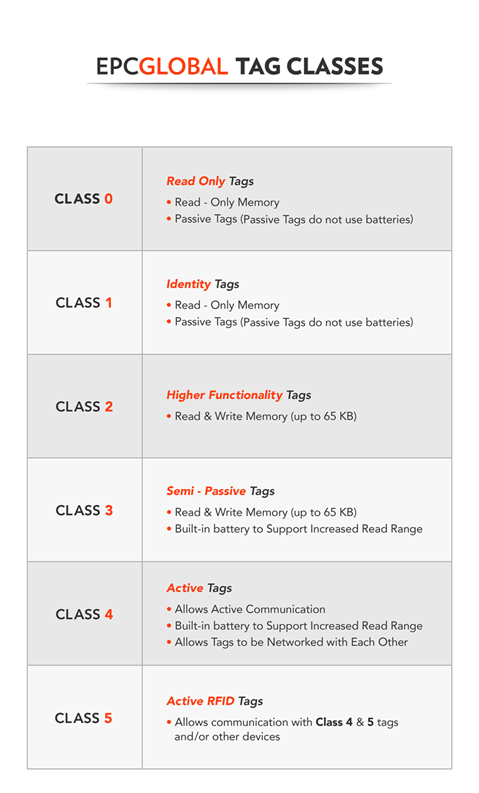
Most RFID tags and barcodes containing Electronic Product Codes are managed according to standards and guidelines created by EPCglobal. EPCglobal established the standard format for the EPC (Electronic Product Code) number, which includes a header, a unique EPC identifier, and a filter value. The organization also developed the standards for Class 1 Gen 2 tags, which were approved by ISO as ISO 18000-6C. Below is a chart of all tag classes currently recognized by EPCglobal.
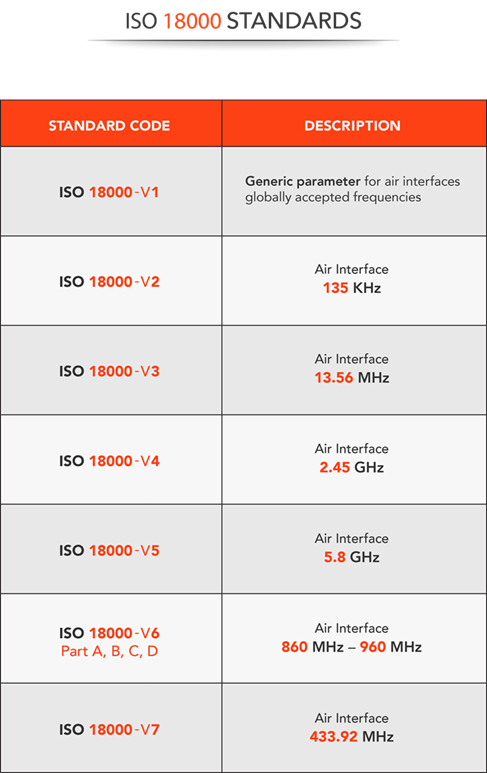
All classes defined by EPCglobal are approved by ISO and the World Trade Organization (WTO). UHF RFID tags utilize the air interface protocol ISO 18000, a protocol developed to specify communication requirements for tags and readers to promote universal adoption. Its significance lies in the regulations applied under the protocol, which describe the approved communication methods between the tag and the reader. Below is a chart showing the 7 parts of the protocol and what type of technology they affect.
ISO 18000-6C
ISO 18000-6C describes the communication standards set for UHF Class 1 Gen 2 ITF or Interrogator-Talks-First RFID readers and tags. ITF RFID systems are characterized by the tag modulating its information and backscattering to the reader (or interrogator) after the reader sends a command.
ISO 18000-6C also defines three other parts of reader-to-tag communication: how the information is encoded, how it is modulated, and the anti-collision protocols used. ISO 18000-6C specifies that UHF Passive systems are ITF and utilize Pulse Interval Encoding (PIE), Amplitude-Shift Keying (ASK), and the Q-algorithm (a form of slotted ALOHA).
Encoding or Bit Encoding
Modulation
Anti-Collision
Bit Encoding and Modulation
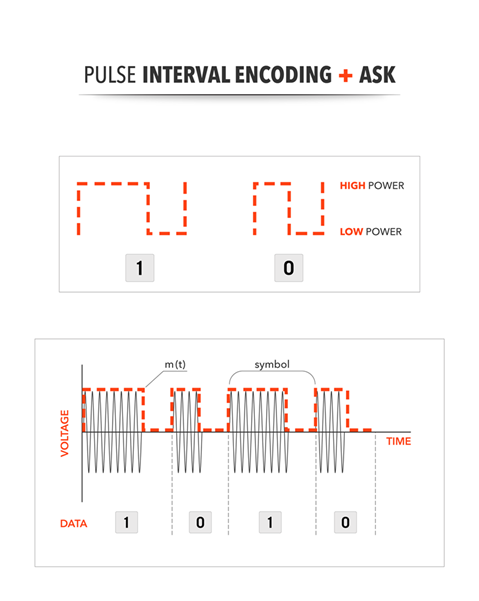
Pulse Interval Encoding (PIE) is used in Class 1 Gen 2 (ISO-18000-6C) equipment for the reader to format communication, and it describes how a message is encoded for transmission from the reader to the tag. Similar to Morse Code, PIE uses long and short pauses to represent a “1” or a “0”. A longer pause indicates a “1”, while a shorter pause means a “0”. In ISO-18000-6C, PIE works in tandem with Amplitude Shift Keying (ASK), which explains how the information is modulated. ASK operates by altering the amplitude of the wave to represent digital data. Below is a chart showing a signal encoded using PIE and modulated with ASK.